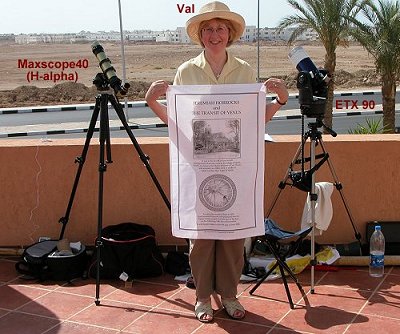
The equipment and Val with special tea towel to cover telescopes
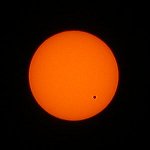
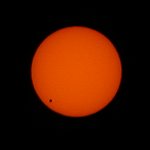
All photographs are Alt/Az orientation, as seen in the sky.
Summary report
Observed ingress from the Sharm Inn, Sharm el Sheikh, Sinai Peninsula and egress
from the Ocean Club Hotel. Using an
ETX90 with Inconel filter and a Coronado Maxscope40 H-Alpha telescope, both
mounted on camera tripods. Viewing came first and photography second. Took
occasional photos and video during the 6 hour event, but watched ingress and
egress. Black drop seen at ingress in white light, but not in H-alpha. Not as
clear black drop seen in white light at egress, but again not in H-alpha. Val
did some rough sketches of ingress and egress. Timings of ingress and egress
noted using GPS.
Detailed blow-by-blow account
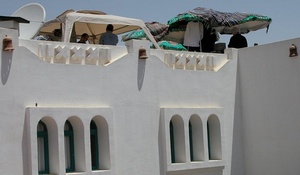
We were in the Sharm Inn, just up the road from the Ocean Club Hotel, the latter being where the majority of the Explorers' group had accommodation. Also, the BBC were due to be filming from the Ocean Club and having a live link with home so that they could transmit live pictures back to the BBC programmes. Despite the possibility of being on the TV and not being where all the "action" may take place, we had decided to set up our equipment on the flat front roof terrace of the Sharm Inn, so as to observe ingress without any distractions. The plan then was to wander down to the Ocean Club after about an hour or so to see what was happening there and maybe come back to the Sharm Inn to observe egress.
Tuesday 8th June dawned sunny and cloudless in Sinai (as predicted!) so we had an early breakfast and started setting up our equipment about 7.30 am local time (i.e.. 3 hours ahead of UT). We had an ETX 90 with a Thousand Oaks Inconel filter - to observe in "white light", and a Coronado Maxscope40 H-alpha telescope.
The equipment and Val with special tea towel to cover
telescopes
Also 2 pairs of binoculars, one with Mylar and the other with black polymer filters, and two black polymer solar viewers (as supplied by the BAA). Camera equipment was a Canon DV600i with black polymer filter (for occasional tripod mounted video sequences), a Nikon Coolpix 5700 (for occasional hand held or tripod mounted direct solar pictures), a Canon digital Ixus (for occasional afocal telescope shots), a Canon EOS 300 with 300mm lens plus 2x teleconverter with Thousand Oaks Inconel filter containing 200 ISO slide film (for occasional hand held solar pictures), and a Pentax Espio 140 with 200 ISO slide film (for ambience pictures). Having only brought two tripods, photography was second to observing, as the Maxscope 40 had to be removed from its tripod each time a tripod-mounted photo was taken.
We were set up before 8 am. A few others were also setting up there: other equipment included another ETX90, a Questar, a Solarscope (projection box), a Coronado H-alpha Maxscope60, and later a binocular H-alpha set up. Also a few cameras and some people just with hand held solar viewers.
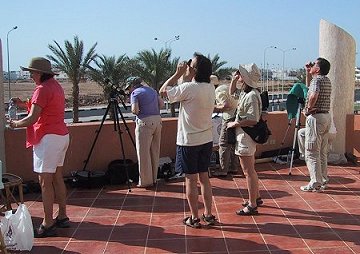
Fellow observers at the Sharm Inn
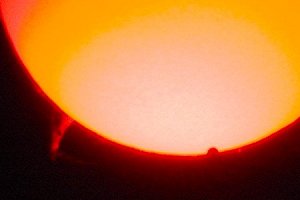
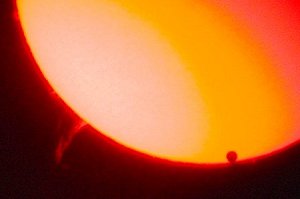
Prior to the start of the transit, viewing through the Coronado, there was a large prominence, about the 5 o'clock position as viewed through the telescope (i.e.. flipped L/R, but correct up/down). Others had a look, and were impressed! The only sunspots visible were two small ones near the centre of the solar disc.
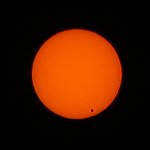
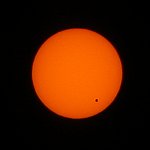
Andrew observed with the Coronado and Val observed with the ETX90. Watching for ingress, Andrew said he could see a notch on the Sun's limb just to left of 6 o'clock position on Sun - Val went across to have a look and confirmed first contact for Venus in H-alpha (didn't note time). Val saw first contact in white light at 5:19:46 UT. (Although by the time I had seen it, called out and asked for the time, it could have been a few seconds earlier than this.) We estimated that first contact in H-alpha was at least 45 seconds before that in white light. Both continued to watch the progress of Venus's disc slowly moving onto the Sun. When Venus was about half onto the Sun, we let others around have a look through both telescopes. We also looked at a projected image in a Solarscope. Then watched for 2nd contact.
|
|
|
When Venus was about 2/3 to 3/4 onto the solar disc, I thought I could see an aureole round Venus's limb, persisting till Venus was about 5/6 onto disc (5:33:54 UT). At this point it was as though I could see the rest of Venus against the black sky (probably an illusion/imagination?). Did a couple of rough sketches. All disc of Venus was on sun at 5:37:23. Then it drew a collar of black after it, narrowing down to a bar (5:38:43), narrowing down and fading to a grey line. By 5:39:02, I could see sunlight all round Venus. Did sketches when asked Andrew for timings. (Times taken from Garmin GPS 12.) Definitely a "black drop" effect in white light, but no discernible black drop seen in H-alpha.
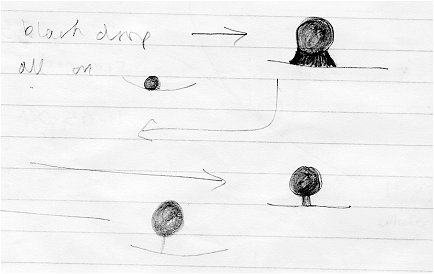
Some of Val's original sketches of the black drop at ingress

Rough sketches of ingress and egress redrawn
People viewing with naked eye using solar viewers couldn't see Venus against the sun until it was about 1 diameter onto the disc. Then Venus was discernible as a small black dot, visible without magnification.
Another Explorers' person, John, had also been sketching the ingress and came over to compare notes. We had got very similar results, except John had seen a few more phenomena, such as a separation between Venus and the sun's limb when Venus was about half onto the sun.
During and after ingress, took some hand held photos with Canon SLR, direct with Nikon digital and afocal with Canon Ixus through Coronado. Captured large prominence with Ixus (see above). Noted that this prominence was curved at first, then straightened, and dissipated quickly and by about 9 am local time it had more or less dispersed.
|
|
|
|
|
Val saw the security staff at the Sharm Inn looking through a solar viewer outside the front of the hotel, and beckoned them up to have a look through the telescopes. They were surprised to be asked and pleased to look at a magnified image. After the 3 of them had looked, they must have told their pals, as we had a stream of waiters and hotel staff coming to view. Some were particularly interested and wanted to know all about it and when the next one would be.
We stayed there till about 10 am local time and, after having a refreshing drink, took the Coronado down to the Ocean Club Hotel and set it up in the Sunset Bar.
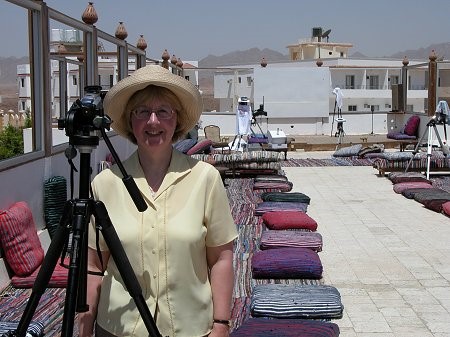
Val in the Sunset bar - Camcorder on tripod
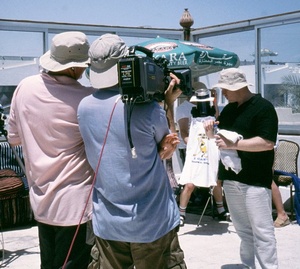
A number of people came and had a look - and then brought/sent their friends - as it was the first time many had seen an H-alpha view of the sun for themselves. We saw the BBC with their equipment on the roof of the hotel.
|
|
|
The BBC floor manager came to recce the Sunset Bar and asked if we would stay there with the telescope as they would be filming 3rd contact from there and wanted to interview people and to have people doing things when they went live for the programme in the UK. So Andrew brought the ETX down from the Sharm Inn and set it up. We observed every so often, took some photos, either hand held or on the tripod after temporarily swopping the camera for the Coronado. Also had some lunch.
|
|
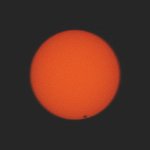
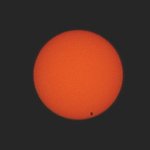
All photographs shown were taken on an Alt/Az mount. As the sun passed overhead at local noon, it essentially "rolled" over resulting in the telescope adjustments being reversed, and Venus looking as though it had doubled back on itself. |
|
Also just before 3rd contact a chap came up to Andrew and asked if he could look through his telescope for 3rd contact so he could sketch it - you can guess Andrew's answer - he hadn't carried the equipment from the UK for someone else to view the crucial bit of the transit. Then the chap came and asked me for the same favour - my answer was the same as Andrew's. We had decided prior to the holiday that we would view the actual ingress and egress, but would be happy to let anyone else look at other times - which we did, so we didn't feel bad about it!
About 11:02:45 UT, I could see the aureole round Venus. Then at 11:04:33 I think Venus had a short bar joining it to the Suns limb (but I could have been swayed by John Mason calling out that he could see it), but definitely there was a short collar at 11:05:04, and then the limb of Venus touched the Sun's limb about 11:06:51. By 11:07:32 Venus was definitely moving off the sun. Black drop effect was much less pronounced at 3rd contact and more difficult to see. Andrew estimated 3rd contact was 11:07:45 in H-alpha (about 54 seconds after white light). No discernible black drop effect in H-alpha. Then we both watched as Venus moved off the sun. 4th contact in white light was estimated as 11:23:36 and in H alpha as 11:24:20 (about 44 seconds after white light). Did some rough sketches from 3rd to 4th contacts and asked Andrew for timings.
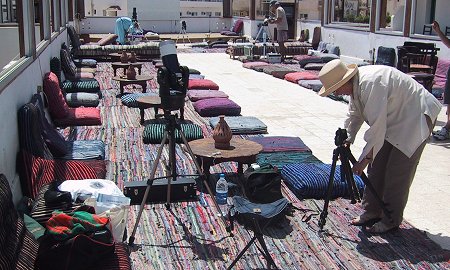
Packing up straight after egress
Altogether a very successful observation. Not many photos taken, but I'm sure others will have taken plenty!
Locations
|
Sharm Inn, Sharm El Sheikh |
Lat: 27 degrees 52 minutes 26.8 secs N |
|
Ocean Club Hotel |
Lat: 27 degrees 52 minutes 17.5 secs N |
Summary of timings
|
UT time |
Contact times |
Other effects |
|
~5:19:00 |
1st contact in H-alpha |
|
|
5:19:46 |
1st contact in white light |
|
|
5:37:23 |
All disc of Venus on Sun |
|
|
Collar of black between Venus and sun s limb |
||
|
5:38:43 |
Strip of black between Venus and sun s limb |
|
|
5:39:02 |
2nd contact in white light |
i.e. sunlight seen all round Venus s disc |
|
6:22 |
Estimated Venus to be 2 diameters onto sun |
|
|
8:05 |
Estimated Venus to be 3-4 diameters onto sun |
|
|
11:04:33 |
|
First sight of narrow strip of black between Venus and Sun s limb |
|
11:05:04 |
Small collar of black between Venus and sun s limb |
|
|
11:06:51 |
3rd contact in white light |
Venus limb touching sun s limb |
|
11:07:32 |
Venus definitely moving off sun |
|
|
11:07:45 |
3rd contact in H-alpha |
|
|
11:09:45 |
Venus 2/3 left on sun in white light |
|
|
11:15:44 |
Venus 1/2 left on sun in white light |
|
|
11:18:xx |
Venus 1/2 left on sun in H-alpha |
|
|
11:19:35 |
Venus 1/3 left on sun in white light |
|
|
11:23:36 |
4th contact in white light |
|
|
11:24:20 |
4th contact in H-alpha |
Temperature readings
|
Local time |
Temp in shade |
Temp in Sun |
Humidity |
|
8:15 |
31.6 |
35.1 |
36 |
|
8:53 |
32.4 |
36.4 |
34 |
|
9:18 |
32.9 |
37.9 |
34 |
|
10:05 |
33.6 |
39.6 |
33 |
|
10:45 |
46.3 |
47.3 |
28 |
|
10:56 |
40.9 |
44.4 |
27 |
|
~13.00 |
~45 |
~53 (on table top) |
Return to Total Transit Experience home page